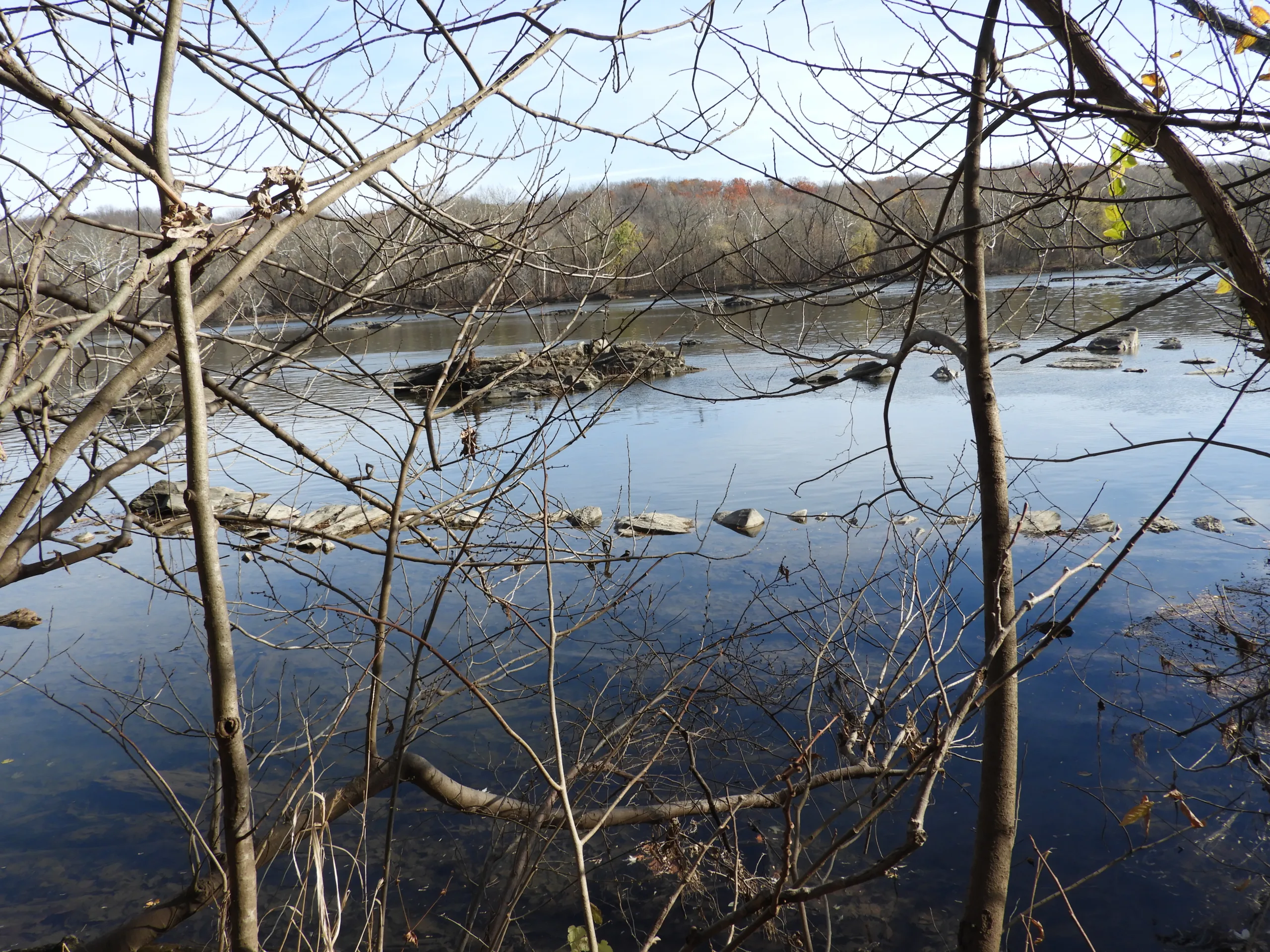
One of the great advantages of living in Leesburg, VA is our proximity to the Potomac River. Even though the river actually belongs to Maryland for reasons which I won’t discuss here, we Virginians are free to explore its many islands, beaches and historical relics. Across the river in Maryland are the remnants of the famous Chesapeake and Ohio Canal initiated in 1828. The shoreline is now a national park stretching for 185 miles from Georgetown to Cumberland, the full length of the canal.
Maryland’s canal often overshadows George Washington’s earlier attempt to make the Potomac River navigable via the Potomac Company. Though Washington’s company completed some grand works, in particular canals around Great Falls and Little Falls, much of its work was far less spectacular. The Company starting in 1785 sent groups of men up and down the Potomac and all of its tributaries with the chore of “getting the rocks out of the way” using human muscle and explosive black powder.
Their job was to build sluices wherever the river was impassable because of shallow water, rapids or rocks. The sluices deepened the river and were usually surrounded by rock walls which strengthened and defined the channel. Very few of these sluices are actually recorded as these teams were apparently better at blowing up the riverbed then keeping detailed notes on their accomplishments.
Recently, I came across a document from the Virginia Department of Historical Resources (DHR) titled “Navigating the Navigational Works on the ‘Patowmack’” from January 2023 which discusses a sluice at Riverbend Park which is just upriver from Great Falls Park and only about one half an hour from my home. Before I even finished the article, I grabbed my camera and was off to see this marvelous sight/site.
Arriving at Riverbend Park, the weather was perfect, warm and sunny, and so was the river, the water transparent and shallow. As I walked down river from the boat launch, I saw under the water what appeared to be a stone wall whose height just reached the top of the water. Because of the large sycamore trees which lined the shore and gracefully arched over the river I was not able to get a good picture. Fortunately, a young man asked what I was doing. He offered to climb a tree out over the river to get a better picture. He did and that picture, among others is below.
Beyond the stone wall out further in the river their appeared to be the remains of another stone wall which would have comprised the outer wall of the sluice. According to DHR document the inner stone wall is “an almost 80-meter (263 feet) line of stones, some as large a coffin, laid along the Virginia bank of the river.” Furthermore, “The wall of the sluice is constructed of long slabs of stone, overlapping like fish scales. As water passes over, especially strong flood currents, water pressure applies downward force to the wall, keeping it in place.”
Friends this stone wall was probably built around 1800, so it has survived Potomac River floods for 225 years! Imagine that! What would Robert Frost think about this, who, reflecting on his New England stone walls, wrote:
Something there is that doesn’t love a wall,
That sends the frozen-ground-swell under it,
And spills the upper boulders in the sun;
And makes gaps even two can pass abreast.
Apparently, this southern crew of laborers and slaves knew something that the Massachusetts farmers did not…the secret of building a wall which lasts forever!
A few days later, on the recommendation of my archeologist friend Bob I wrote to Brendan Burke who is the State Underwater Archaeologist for the Virginia Department of Historic Resources It turns out that Brendan was one of the investigators from the original report and generously sent me his notes on the investigation. He suggested that the outer wall of the sluice was not a wall at all but an island which has disappeared over time. He recommended I take a look at old areal pictures of the site. Fortunately, Fairfax County’s Historical Imagery Viewer is on-line and open to the public.
I was able to compare the Riverbend site now to a picture from 1927, the earliest aerial photo available. Lo and behold, in the 1927 picture is a large island which would have comprised the outer wall of the sluice while in the 2024 photo, there is no island at all!
Think about this, a natural island is washed away by the constantly erosive action of the river while a manmade wall still remains.
-end-


Compare the 1927 aerial picture of Riverbend Park on the left to the 2024 picture on the left. Notice the large offshore islands have disappeared. These would have formed the outer wall of the sluice.
Leave a Reply